
Jeetu, as he is known in the IAF, is known for his high intellect, ability to quickly grasp the essentials of complex situations and the readiness to articulate his views clearly and unambiguously. An excellent professional in every sense of the word, he has a well-trained military mind, honed by extensive operational flying and flight testing experience, avers Air Marshal B Manikantan (retd).

Lieutenant General Seth's involvement in the army's capability development and modernisation efforts is evident from the key appointments he has held in the Strategic Planning and Capability Development Directorates, including Colonel Capability Development for Mechanised Forces, Brigadier Perspective Plans and Acquisition, and Additional Director General Capability Development.

Iran's state media cited the spokesperson for the Central Headquarters of Iran's military to claim that a United States military refuelling plane was shot down by a missile fired by resistance groups in western Iraq. The spokesperson further told Press TV that all six service members on board had been killed.

The Israeli Air Force (IAF) said it struck several targets in Tehran, Shiraz and Ahvaz simultaneously over the past 24 hours, targeting sites linked to Iran's ballistic missile programme, air defence systems and military headquarters.

Rescue operations are currently underway, and the circumstances surrounding the incident are under investigation, the command said.

The first joint theatre command would be responsible for the border against Pakistan in what the military refers to as the "western theatre"; while a second command -- the northern theatre command -- would be responsible for the border with China. A third, navy-heavy theatre, called the "maritime command" will be responsible for the security of the Indian Ocean Region (IOR); and an island command, already functional and called the Andaman & Nicobar Command (ANC), would project power into the eastern Indian Ocean.

Indian Air Force chief Air Marshal S P Tyagi on Monday denied that private airliners were luring away IAF pilots by offering them attractive salaries.\n\n
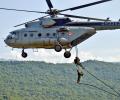
Glimpses from the Indian Air Force air show in Udhampur.

Indian Air Force Chief P V Naik on Wednesday downplayed the Chinese threat, saying there have not been any air incursions along the Line of Actual Control. Air Chief Marshal Naik said, "Our strategy is to play it cool. We are not downplaying anything. As far as the Air Force is concerned, there has been no reason to downplay anything. There have not been any incursions reported at the LAC." He also hinted that the Indian Air Force is upscaling its strength.

A French soldier was killed while several others were injured in an attack in the Erbil region of Iraq, French President Emmanuel Macron confirmed. Macron, in a post on X, confirmed that Chief Warrant Officer Arnaud Frion of the 7th Battalion of Chasseurs Alpins lost his life in the attack.

After Operation Sindoor, the Army and Navy now view the IAF as not a supporting arm, but the spearhead of India's warfighting capability, capable of decisive outcomes across domains, explains Air Commodore Nitin Sathe (retd).
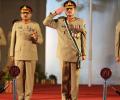
Vice Admiral K Swaminathan highlights concerns over Pakistan's arms procurement and China's growing assertiveness in the Indian Ocean Region.
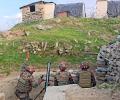
'With a military-led strategy to counter terrorism emanating from Pakistan, India has clearly signalled that it would respond decisively to future terrorist threats.'
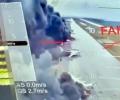
Ukrainian forces conducted large-scale drone strikes on several air bases deep inside Russia, destroying multiple combat planes, Ukrainian Security Service (SBU) said on Sunday.

The meeting was conducted over a period of two days from February 24 to 25.

Mere shuffling of resources or cosmetic changes to prove a point would be counterproductive in the long run, observes Commodore Venugoptal Menon (retd).

INS Tamal is the eighth Krivak class frigates to be inducted from Russia over the past two decades.
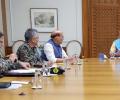
India has called Pakistan's nuclear bluff with Operation Sindoor and sent a psychological message to state-sponsored terrorists: nobody is untouchable and no place in Pakistan is safe for you, government sources said on Sunday.

The resumption of two-carrier operations signals India's return to the elite clutch of navies that have the ship platforms and experience for operations that simultaneously involve more than one aircraft carrier.
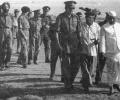
In what was perhaps the most critical meeting before full-scale war broke out, Shastri defined India's immediate war objectives to his defence minister, army, and air force chiefs: 'To defend against Pakistan's attempts to grab Kashmir by force and to make it abundantly clear that Pakistan would never be allowed to wrest Kashmir from India; To destroy the offensive power of Pakistan's armed forces...' A fascinating excerpt from Shiv Kunal Verma's must-read 1965: A Western Sunrise India's War With Pakistan.
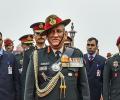
The creation of a CDS has got the head right. Issues that were not talked about for years are now being discussed, points out Ajai Shukla.
India has to fill in all the critical gaps in missiles, ammunition, sensors and stockpile in the fastest possible manner, focusing on the critical instruments that worked this time, asserts Shekhar Gupta.
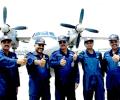
The sortie had to be executed in good weather and in sub-zero temperatures, which meant it was to be accomplished by mid or third week in May before the earth heated up and the monsoon clouds made things difficult.

Gen Pande, who was serving as the vice chief, became the first officer from the Corps of Engineers to helm the force.
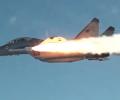
'For weeks, months and years, it would continue to be debated if India should have pushed the early advantage and decapacitated Pakistan militarily.' 'India refused to bite the provocatively proverbial bullet and escalate it into a full-fledged war,' notes N Sathiya Moorthy.

Lt Col Hecht spoke as the Israel Air Force killed Merad Abu Merad, Hamas' head of aerial activity, in Gaza City, who it said was responsible for directing terrorists during the October 7 massacre of Israelis in the western Negev.

The Navy Chief issued directions to make INS Brahmaputra seaworthy and combat ready.

The Chinese have just one commander for all the forces confronting India. Commanders of all these forces answer to one man, and one headquarter. India, on the other hand, offers a diversity of options that is a military embarrassment in the 21st century. In Arunachal and Sikkim-Bhutan, the Eastern Army Commander is in charge. In the Uttarakhand (central) sector, it will be the Central Army Commander. The Himachal-Tibet border is the domain of the Western Army Commander. And all of Kashmir and Ladakh further on, the Northern Army's. Effectively, an array of at least eight 'three-star' commanders will be arrayed against one Chinese, says Shekhar Gupta.

'China would rather tie us down; and bleed us as much as it can so that we aren't able to lift our heads to face them.'
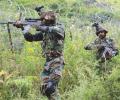
As India progresses towards formulating its own model of theaterisation, the public must get involved in the debate because in the end, it affects the well-being of the entire nation, asserts Biswajit Dasgupta.

The tearing hurry to form theatre commands has to be replaced by a balanced and deliberate approach. We need to accept that this process will take time if executed correctly and in the best interests of the Indian armed forces, argues Commodore Venugopal Menon (retd).
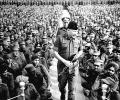
'We failed as a country because those who should have been there to say goodbye did not show up.'

The black box, comprising the flight data recorder (FDR) and the cockpit voice recorder (CVR), of the ill-fated Mi-17V5 helicopter of the Indian Air Force was recovered from the crash site on Thursday.

The IAF has already set up a dedicated operations direction centre for coordinating various aspects of the arrangements with security agencies concerned, they said.
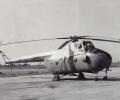
The retreating Pakistani troops were heading towards Dacca and they had to be stopped at all costs. The Eastern Army Commander, in his orders to General Sagat Singh, had reiterated that he did not want the troops of 4 Corps to cross the Meghna river. But General Sagat had other plans to threaten Dacca and ensure that the pressure would make the Pakistani commanders capitulate. This is where the IAF helicopters came in.

Teams of the National Disaster Response Force started landing in Gujarat with the help of the Indian Air Force to undertake preventive evacuation of people living on the west coast, an IAF official said.

The 1971 war reaffirmed the importance of inspirational senior leadership in battle and heralded the emergence of a new fighting class amongst officers and men of India's armed forces.

Arjan Singh, the Marshal of the Indian Air Force, was a fearless and exceptional pilot and remained a source of inspiration to all personnel of the Armed Forces through the years.

'Unlike on the western and eastern borders where there is an enemy at the gate, here there is an invisible enemy which is building its own capability and can come into play at a time and place of his choosing.'

Lt Gen Bakshi announced 'full support' to the new chief and made it clear that he won't resign.
